Made by a driver, for other drivers

Pick the hourly you want to keep — after the car.
Roadnomics helps you hit it.

The iOS app that counts what driving really costs, so you know what you actually keep.

Work it out from your car →

Drag either number. The three offers are examples, shaped like real ones, and the call on each changes with them.

$16.85UberX · 1.7 mi, 5 min to the pickup · 6.5 mi, 17 min trip · Somerville to Medford, 4.68 rider, 2 stops

$9.40UberX · 3.1 mi, 9 min to the pickup · 2.4 mi, 8 min trip · Cambridge to Allston

$38.20UberX · 2.0 mi, 6 min to the pickup · 21 mi, 34 min trip · Boston to Framingham

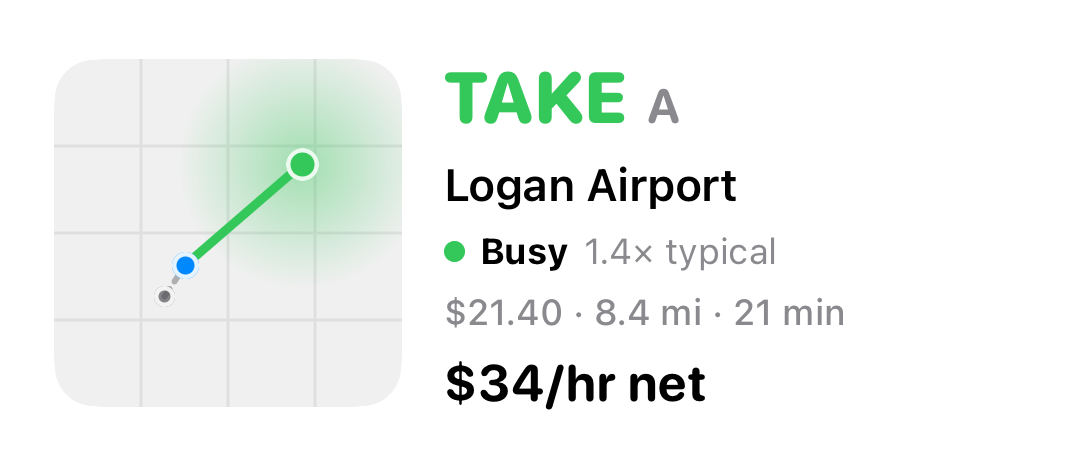
Verdict card: TAKE, grade A, Logan Airport, Busy at 1.4 times typical demand, $34/hr net
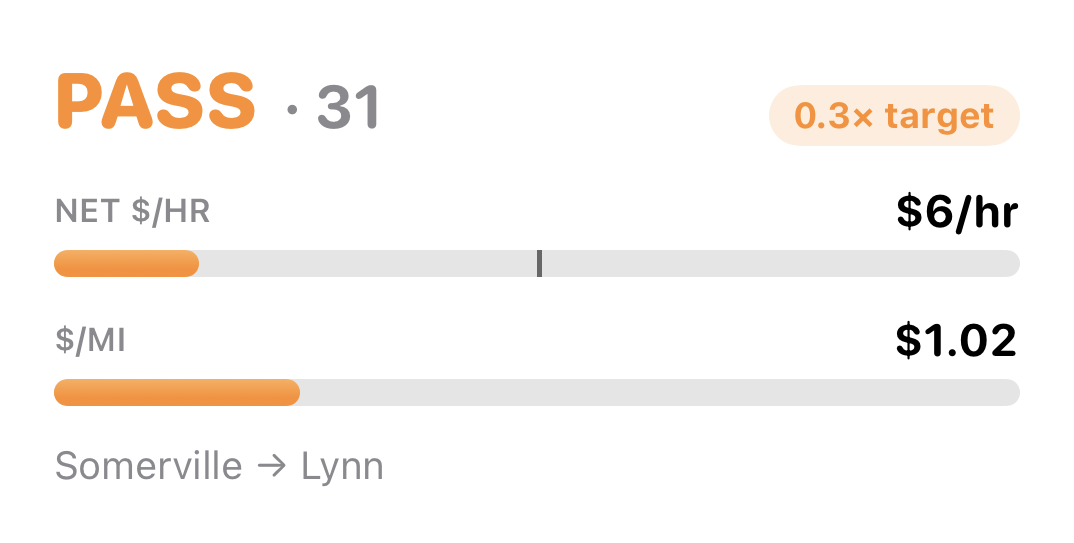
Verdict card: PASS, score 31, net $6/hr against a $21/hr target, Somerville to Lynn

How it works

Set your number. Then plan, earn, learn.

Your car, the hourly you want to keep after it — two minutes, once. Everything after that is measured against that number.

  1. 1

    Plan

    Be where the work is about to be: tonight’s let-outs, and the hours that have already paid you.

  2. 2

    Earn

    Every offer is checked against your number and spoken out loud, take or pass, while the offer is still on the screen.

  3. 3

    Learn

    Every trip is logged and graded on what you kept. What paid becomes next week’s plan — and the loop goes around again.

One shift

A Tuesday, the way the app sees it.

Four moments. The plan for the night, one offer landing at 2:28, the ride that followed, and what the day was worth once it was over.

Plan · Your week

Plan the week. Not just the next ping.

Your own trips, sorted by day and time of day: which mornings paid, which Friday nights didn’t, neighborhood by neighborhood. Your rides, reservations and tonight’s events sit on the same calendar.

  • Every neighborhood as a grid, early morning to late night, each slot at your own $/hr
  • Your week on a calendar: what each day earned, and what it came to per hour
  • Tonight’s events on the agenda, with predicted let-out times
Today on the Schedule: the week strip, the day's rides, earnings and $/hr, and tonight's Red Sox and TD Garden let-outs on the agenda
schedule-events.png 1290 × 2796 Day agenda + events tray
Davis Square: profitability by slot, your all-time dollars an hour for each weekday and time of day, Friday and Saturday nights darkest
neighborhood-slots.png 1290 × 2796 Profitability by slot

Who made this, and why

I built something for my passengers first. They ignored it.

I started driving because I liked the job. The money came later. The first thing I built was for my riders: a tablet in the back seat, in a proper mount I bought for it.

Riders could change the radio from it. On airport runs it showed their flight and whether it was on time. It also translated in real time, so I could talk with riders I didn’t share a language with.

Nobody looked at it. Every seat-back screen they’d ever seen was full of ads, so they’d stopped looking at those screens long before they got in my car.

So I started building for myself instead, and noticed something. Whenever I had better information, I made more money. I wasn’t driving longer or harder. I just knew more: where demand was heading, what a mile really cost me, and which offers were losing me money.

That’s the idea. You pick the hourly you want to keep after the car, and the app gives you the information to get there. I still drive, and I still use it.

A lot of what I know about driving came from other drivers, people who passed along what they’d learned with nothing to gain from it. This is my way of passing something back.

Some of it will cost money, because some of it costs money to run. I’d rather say that up front. But I pay the same expenses you do, so these will always be free:

  • Knowing what you actually earned. Your real $/hr, after what the miles cost you.
  • Basic trip evaluation. Whether the offer in front of you pays.
  • Mileage tracking. Every mile, recorded.
  • Exporting your own data. All of it, whenever you want, in a format you can use somewhere else.

I haven’t decided exactly where free ends and paid begins. When I do, I’ll post it here, and I won’t move the line on anyone already using the app.

I’ve been a software engineer my whole career, and I built this the way I’d build anything at work.

Questions

Straight answers.

What do I need to run it?

An iPhone on iOS 26 or later. That's it — no dongle, no subscription to a data service, nothing mounted to your windshield.

What does “after the car” mean?

Every mile you drive costs you something: fuel at the price you’re paying, depreciation, maintenance, tires, insurance. Roadnomics works that out per mile for your actual car, then subtracts it for every mile of a trip — including the miles out to the pickup. What’s left, divided by the time it took, is the hourly you actually keep. That’s the number you set a target for.

Are the three offers at the top real?

They’re examples, shaped like offers I see every week, so you can watch the call change as you move your number. The two verdict cards further down and the $58-vs-$26 figure are from real trips.

Which platforms does it work with?

Uber and Lyft offers today. The evaluator reads what's on your screen rather than plugging into any platform, so it isn't locked to one app — and it works the same whether you're multi-apping or not.

Does it accept or decline trips for me?

No. Roadnomics never taps, automates, or interacts with your driver app in any way. It reads the offer and tells you what it's worth. Every decision stays yours.

Does it connect to my Uber or Lyft account?

It doesn't. There's nothing to log in to and no account to link. It never signs in as you, never automates anything, and never talks to those companies at all — it reads a screenshot you took, on your own phone, and does the math there. Those are the facts; what you make of them is your call, not mine to make for you.

What happens to my data?

Let me be straight about this, because you've been lied to about it before. I do want it. Watching how the app actually gets used is how it gets better, and a demand model that learns from more drivers is a better model for every driver using it.

What I won't do is sell it. Not to advertisers, not to insurance companies, not to anyone assembling a profile of you. It doesn't go to a third party for any reason other than making this work better for the people driving with it. I'm not in the business of selling drivers — that's the entire reason this exists.

Why does evaluation run on the phone?

Speed. There's no round trip to a server, so the answer is back in about two seconds — while the offer is still on your screen and still worth having an opinion about.

What will it cost?

The beta is free for its full duration. After that, some of it will cost money — parts of this cost real money to run, and I'd rather you hear that from me now than find it later.

Some things stay free permanently: knowing what you actually earned, basic trip evaluation, mileage tracking, and exporting your own data. I haven't drawn the exact line between basic and paid yet. When I do, I'll draw it in the open — and I won't move it on anyone already driving with it.

Do you support DoorDash, Instacart, or the delivery apps?

Not right now, and I want to be honest about why rather than pretend it's a roadmap item. I love driving people. I don't have the same feeling about delivery, and I'd rather build the best possible thing for the job I actually understand than a mediocre version of both. I'm also genuinely bad at parking, which delivery seems to require a lot of.

Once the passenger side is where I want it, it's absolutely on the table.

What if the map sends me somewhere and it's dead?

Then it was wrong, and I'd like to know. Most of what the map shows you isn't a prediction at all — it's things your city has already scheduled, like a game letting out or a show ending. That part is just knowledge you'd have if you had time to look it all up. The part built from your own trips gets better the more trips it has, and it's honest about which is which.

When does the beta start, and where?

Greater Boston first. Other cities come when I have the event and demand data to do them properly, not before. Tell me where you drive when you sign up and I'll know where to look next.

The beta

Get in before the meter starts.

It’s invite-only while I get it right one city at a time, starting with this one. Leave your email and you’re in the first group.

Evaluation runs on your phone — no round trip to a server, so the answer’s back in about two seconds.